Have you ever wondered how and why shifting cultivation is still being practiced in Sarawak? Read on…

Slashed and burned: a hill slope cleared for planting crops.
When I walked through the countryside a few months ago (tail-end of the dry season), I was quite shocked to see so much land in the hills being cleared with fire. It was quite alarming to hear very loud popping and crackling noises coming from distant hills as green vegetation (particularly bamboo clumps) burned. It sounded like hundreds of fireworks going off at the same time.
The noise was so loud I tried to record it on my phone but unfortunately, the resulting audio was really soft so pretty much useless.
The further into the countryside I walked, the more cleared land I saw. I must admit I was quite taken aback at the scale… walking through burnt and charred land with smoking tree trunks was quite unnerving.
So I thought to myself, “I have to post about this” and set off to do a bit of research. I got first hand information from local Bidayuhs practicing this kind of farming. Here’s what I found out…
In preparation for the planting months, farmers, especially those in the interior areas of SW Sarawak often resort to slash and burn techniques to clear their land or farms of secondary growth. This method of farming is regarded as the fastest way of clearing a plot of land. Burning creates a lot of smoke and can cause the atmosphere to become very hazy but it’s necessary to these farmers as burning produces fertile ash and clears the land quickly.
Now, it may seem as though what they are doing is really bad, clearing the jungle with fire but here’s what one should know before judging their way of life…
Most native families in Sarawak own a few plots of land in the rural countryside. They farm these plots on a rotation basis. They do not burn or cut new virgin jungles (indeed, there’s so few to be found in the Kuching area now, outside of national parks) but depend only on their own plots for farming.
For example, a family may own up to 8 or more acres of land. They will then farm 1 acre (slash and burn to create fertile ash), then move on to the next acre the following season. Years would have passed by the time they return to farming the first acre of land again. By this time, that original plot would have been colonized completely by shrubs, small trees, ferns, grasses and bamboo plants. And this is what we often see being burned in this kind of farming.
They will not re-plant an already farmed piece of land, instead, they need to let it become fallow while they farm the next plot. Fallow land is then quickly re-colonized by secondary growth. In these lands, bamboo is one of the fastest, most prolific plants to re-colonize any cleared land since there’s always some live vegetative growth underground that’s not killed by the initial burning.
So if a family owns 8 plots of land and they farm only one plot per year, it would be 8 years passed before they return to farming the first plot. 8 years is a long time for the colonizing plants to grow, thus, covering the fallow land and making it ready to be cut, burned and farmed once again.
See also: www.sarawaklens.com/2011/10/paddy-planting-season-october-2011.html
Photo gallery:

Bamboo and other secondary growth cleared and burned.
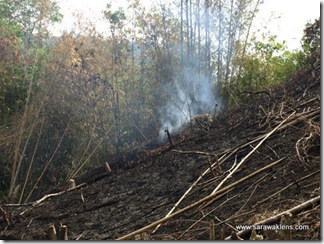
A smouldering tree trunk

A cleared patch far up a distant hill. This hill is quite far away. Had to zoom in then crop the photo to bring the burnt patch in view.

This piece of land is now ready to be planted with whatever the farmer fancies. Here, it looks like it’s going to be turned into a small pepper garden. The hill in the background will most likely be planted with hill paddy.

Durian trees are prized trees but sometimes burning may get out of control and kill a few.

Burning is usually done before the rainy season begins; paddy and other crops are then planted, thriving when the rains begin to fall.

A cleared hill ready to be planted with hill paddy, pepper or other crops.

The charred remains of two large trees (could be durian trees).

Maize stalks line a narrow path.
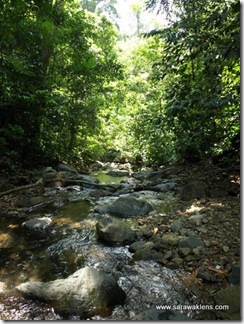
It was a relieve to finally get out of the sun to explore this beautiful mountain stream.
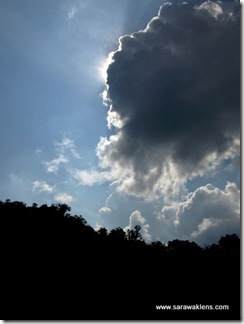
It was very hot even with the sun partially covered by clouds.

There’s a mountain stream flowing through the secondary jungle to the right.

This dead tree is most likely a durian tree. Not sure if it died due to natural causes, lightning or burning. But the base wasn’t charred or showed little signs of fire damage.

A clear foot path runs through this piece of burned land, it is undamaged by the fire which I found it quite interesting. It could be because that the farmers had managed to control the burning well (I noticed in some parts, the path was lined with big bamboo stems) or it could be because the path is mostly clay/exposed soil and has little grass growing on it.

Bamboo clumps and small trees line the top of this hill, undamaged by the fire. I’m speculating here, but it could be that the farmer has cleared enough land for his crops or that other piece may belong to a different family.
I must say that my perception towards shifting cultivation has most definitely changed. Whenever I saw any land being cleared this way, I used to think the farmers were just cutting and burning any random plot idle land! But now I know they’re farming on a rotation basis and they’re only clearing land that they already own and have been farming on for generations.
Think Farmville... plant, harvest, plough (when land becomes fallow), replant. Only in Farmville, the cycle takes only a few hours and over the same plots. ;)
~end~


