
A hungry visitor: With a snail in one pincer and the larva of a firefly beetle in the other, this beautiful land crab with bright red pincers and a purplish body is a welcome find on a rainy evening!
Will update this post once I have an ID.
A hungry visitor: With a snail in one pincer and the larva of a firefly beetle in the other, this beautiful land crab with bright red pincers and a purplish body is a welcome find on a rainy evening!
Will update this post once I have an ID.
While December was relatively dry, January has been quite wet! It’s as if all that December rain was saved up for January and it has been raining nonstop for almost 2 days now. If it’s not a slight drizzle it’s a big downpour! In this kind of weather, snails in the shade house have free reign over my orchids because I can’t sprinkle snail bait without all of it being washed away.
Slugs and snails of all shapes and sizes come out and attack new shoots, leaves and root tips. Big snails, small snails, tiny snails, screw-shaped snails, round snails, transparent snails, only snail missing is a square snail! My phalaenopsis species orchids suffer the most as these pictures tell…

This new leaf would have been a really beautiful shiny broad leaf if it weren’t for those damn tiny monsters!

Reason why many of my species phals do not have perfect foliage.

The older leaves of this Phalaenopsis bellina were damaged by snails when the leaves were still young and just emerging. This is if the bacterial infection doesn’t consume the entire leaf and spread to the crown!

This new leaf on a Phalaenopsis cornu-cervi has also been damaged from the underside. If only I could set up a waterproof time-lapsed camera in the shade house! I’d really like to see how exactly do those buggers create so much damage.

This poor Phalaenopsis corningiana has lost its crown. The rot started from similar damage done to a new emerging leaf like in the first photo above. Thankfully the infected part has dried up and the plant has stabilized. If it remains healthy, it should either put out a new shoot or keiki from the side in a few month’s time. I will then have to be vigilant and prevent snails from damaging the new growth.

This snail is feasting on an infected P. bellina leaf. I showed it no mercy!

Severe leaf rot on a P. bellina leaf. This is usually due to poor air circulation and too much rain! This poor plant lost its crown due to snails and infection several months ago and is just putting out a new keiki. To kill any hiding snails, I was once advised to take entire phal mounts (plants and all) and soak them in a bucket of water added with a a spoonful of salt. I have never done this for fear it may harm the plants as well. Anyone tried that before?

Paphiopedlum stonei. Nice and healthy but look at what’s on that new leaf.

A cone shaped snail and a transparent one that looks like a hybrid between a regular snail and a slug. Paphs do not suffer too much from snails “grazing” on them because their leaves are much thicker and hardier than soft phalaenopsis leaves.

A tiny cone-shaped snail on a Rhyncostylis gigantea leaf.

Too late for this leaf. The damage often start as small spots which quickly turn translucent and infected and spread through the entire leaf. If I fail to remove the affected leaf, the rot may spread to the crown and kill the entire plant.

The silhouette of a tiny voracious monster!
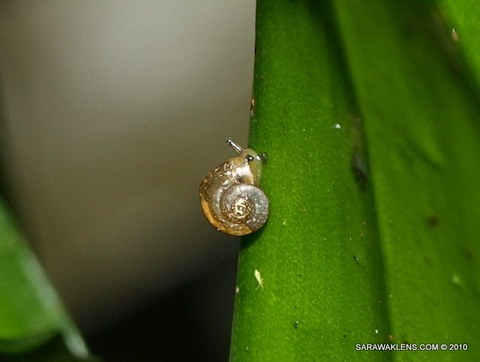
Tiny monster revealed. These tiny round snails are by far the most numerous from my observations. They are very hard to kill because being so tiny, they often do not run into a snail bait. This one is on an Aerides odorata leaf.
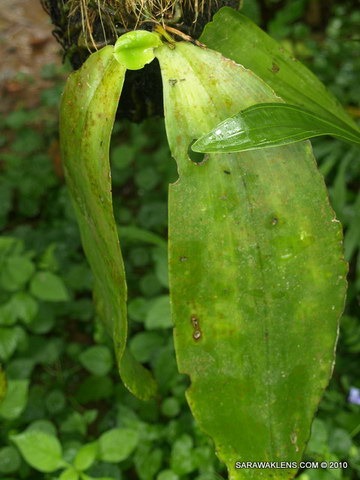
This used to be one of my most beautiful and biggest P. bellina plants. Same story, damaged new leaves, subsequent infection and crown rot. After many months, it has recovered enough to produce a new crown. However, look at what’s hiding under one of the leaves, about to chomp up that juicy succulent new leaf…

A damn snail! Gave it no chance to move any closer to that new leaf before crushing it into goo.

This P. bellina is one of my most cherished plants. That newly opened flower will be damaged overnight if the tiny snails find their way to it.

My Paphiopedilum lowii is not spared from the little monsters. There were several snails in this pot and on the plant!

I have had this Phalaenopsis modesta for more than a year now. It has never had the chance to flourish properly due to constant damage by snails and other pests. I tried moving it to a sheltered area but it protested. I then shifted it to a shady place under a tree and it seemed happy for a while but then the snails arrived. It has gone from a 5 or 6 leaf plant to a single leaf plant and now it’s starting to make a comeback. I’ll have to keep an eye on it.

And finally, the shocker! Rot and infection that started from seemingly minor snail damage can quickly spread through entire plants and entire mounts. This one had 4 or 5 phals on it. Look at it now…

And just as the stems, which were still green and healthy, were about to produce new growths, a slug comes along and chomps up the root tips and new shoots! Slugs are hard to kill as they can’t be crushed easily. Easiest way is to sprinkle a bit of salt on them.
Yes, growing orchids is a lot of hard work. One can see why I’ve given up adding more to my collection. However, I have invested a lot of time and $$ into my existing collection so I’m not giving up on them yet!
First, a special msg to my visitors from France!
Bonjour amis de France. Bienvenue, merci de visiter mon blog de votre forum. Je sais que vous amour phals, moi aussi, j’aime phals! Mais regardez mes plants et les adultes plantes, ils ont ete attaques par escargots. Les escargots sont d'un pot prises a l'exterieur. Je deteste escargots!
Yesterday evening I had quite a rude shock when I found many of my phal seedlings, big and small, in very bad condition with leaves chomped on by snails. It was still light so I found only one medium sized snail and one small slug, the rest must have been hiding away under pots and in the media.
The damage was pretty bad. Some large ones were eaten right down to the stem. This one, in the above photo, was just recovering from a bad spider mite attack but look at what’s happened to it. From spider mites to snails, my poor phals!
So last night, after a heavy rain, I opened a packet of snail poison and placed the granules all around the pots, in the pots, in the media and sprinkled some below the seedling rack as well. This morning, I woke up to find countless snails of all sizes dead (or dying)!

A big common garden snail, imagine if this one had gone unnoticed! Many of my phals in the seedling/nursery area would have been eaten up by this monster!

The snail poison is very effective but I cannot stand the smell, it nearly knocked me out when I popped the packet open. I have to wear a mask in the future.

Besides the big ones, there are also plenty of tiny ones everywhere. These are the most difficult to deal with as they can hide in the smallest crevices. Also, because of their size, they often do not encounter a snail bait. For such small ones, I have to sprinkle a bit of the snail poison in powdered or crushed form. These tiny ones are probably the young newly hatched snails of the type in the photo below.

Besides phals, they attack my vanda seedlings placed in the same area as well. Their favorite item on the menu is a new juicy, succulent phalaenopsis leaf or root tip. They cause a lot of damage because the affected leaves often become infected and the rot spreads down to the crown. Many of my species phals do not have perfect foliage because of the snails. It’s a never ending battle!

Imagine if I had not laid out the poison last night, this small hybrid phal seedling would not have seen the light of day!
I never had any problems with snails in the nursery area before because it is in a covered area at the side of the house. These snails must have come from a pot introduced carelessly from the main shade house as plants were being shifted around due to the heavy rain we’ve been getting recently.
For the next few weeks I have to sprinkle the snail poison diligently once per week to try and kill all of the intruders. Hopefully things will return to normal and the survivors will recover. Geez, from spider mites to caterpillars to snails, do you guys living and growing orchids in temperate and colder regions experience the same problems we do here in the tropics?


