Sunday, November 27, 2011

Variegated tapioca

Variegated tapioca2
Beautiful foliage…

While hiking through the countryside last week, came across this small tapioca plant with variegated leaves (Manihot esculenta?). I’ve never seen one like it before… it was found growing by the side of an overgrown footpath leading to an abandoned vegetable patch.

Variegated tapioca

Read this: http://paducahsun.com/bookmark/13649442-Variegated-tapioca-a-real-landscape-thriller

So it’s native to South America, hmm… I wonder if the tubers are also eaten; we do eat tapioca tubers here but this is the first I’ve ever come across this variety.

Tapiocas are easy to propagate via stem cuttings so I kind of wish I had taken a stem cutting or two because it’s quite an attractive plant.

Saturday, November 26, 2011

It’s an Indian Cuckoo! (myth of the “durian bird” finally cracked!)

See also: It’s durian season!

Back in 2009, I posted this entry entitled “It’s durian season!” and wrote a bit about the elusive “durian bird” which I had been trying to photograph since forever and a half.

Well, yesterday as I was writing on my laptop at home, I heard the bird’s unmistakeable loud calls “kang kang kang koook - kang kang kang kook” and quickly grabbed the Nikon + 70-300mm and went outside to look for it.

Indian_cuckoo2

At first, I couldn’t locate it but I knew it was perched high up our tallest durian tree. As it called out again, I spotted it, partially hidden by leaves and branches. I’d been trying for so long to get a photo of this bird so imagine my excitement! Upon spotting it with the zoom lens, I knew immediately it was some kind of cuckoo.

Actually, I’ve been asking my birding friends forever about this bird but none of them knew what it was (which was really surprising and a bit frustrating too since they seem like hardcore birders, and this bird is often heard calling through the jungles, orchards and even some gardens). So I was really pleased with myself for having identified it finally after so many years! It’s the Indian cuckoo (Cuculus micropterus).

Indian_cuckoo1

Now, some of you may regard this a fairly common bird; perhaps you’ve spotted it several times yourself but I'll tell you why I was so excited to finally photograph/identify it in a bit...

Anyway, afraid that it would suddenly fly off, I didn’t try to get a better view before snapping a series of shots. Then I shifted to a better spot, changed some settings on camera and snapped about a hundred photos of this bird! LOL I was hoping to get some useable shots since our tree is really tall and the bird was so high up it was beyond “sharp and clear” reach of the 70-300mm (these photos are all highly cropped photos).

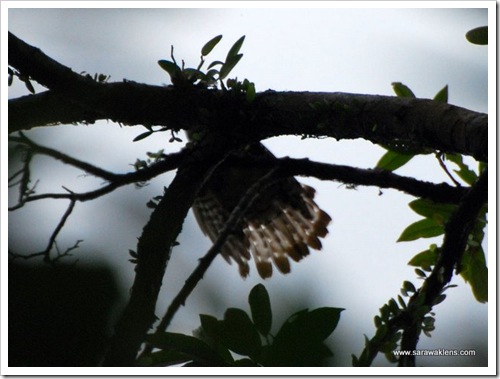
This is a really LOUD bird, its calls can go on and on throughout the evening, sometimes well into the night. This bird I photographed was cleaning and preening its feathers in the light rain, stopping to call out every now and then.

Refer my 2009 posting “It’s durian season!”  where I mentioned a local myth about this bird. It’s sometimes called the “durian bird” or “liulian chiao” in Hokkien because some people believe it has the power to make durian trees flower and fruit! Each time a bird lands in a tall durian tree and starts to call, that particular tree is bound to bear lots of fruits come fruiting season. This believe came about from local observation over several generations. In fact, my father told me of a Bidayuh poem that was inspired by this very bird! It goes something like this:

Kang-kang-kang kuk,
Nimang bua’ tibaga,
Pe’on mu bojang dunuk,
Masih mu karik kaya


And here’s the rough translation:
Kang-kang-kang kuk,(call of the Indian cuckoo)
Nimang bua’ tibaga,Singing (a song of praise) to the copper fruit (“copper fruit” could be referring to durian?)Pe’on mu bojang dunuk,Though you’re limping on one footMasih mu karik kayaStill you search for wealth (food)

I had long suspected the myth came about from the fact that the bird just likes tall trees and happen to visit durian trees because they’re the commonest of tall (cultivated) trees in the Kuching countryside! And because the bird’s breeding season happens to coincide with the durian flowering season (usually end of year or start of rainy season), people thought that it had the “magical powers” to cause durian trees to flower and fruit! Hence, durian bird! :))

Indian_cuckoo3


Like other cuckoos, the Indian cuckoo is a parasitic nester. You’ve probably watched how cuckoos lay their eggs in another bird’s nest on TV, right? It’s usually just a single egg which hatches sooner than the host bird’s own eggs. The young chick then pushes out the other eggs and takes over the entire nest. The host bird continues to feed the chick like its own even as the young cuckoo grows to a size much bigger than the host parent.

This is a bird I’d always known as the “durian bird” since I was a little kid. So having finally identified it, I must admit, it has lost much of its mysteriousness. It’s not as exciting anymore when we hear it calling haha. However, I will end with this funny but true tale… believe what you will…

About a week ago, we first heard this bird calling (this season) briefly but loudly on our tallest durian tree. The next morning, we looked up the tree and found this:

durians

TWO durian fruits on one of the lower branches!!! We had been keeping an eye out for fruits on this particular tree for quite sometime but never found any but after the bird visited our tree, we found two the very next morning! It was as if the fruits “magically” appeared!

We’ll be having some yummy durians a few weeks from now. :)))

Friday, November 25, 2011

Samsung EX1 night shots (Kuching Waterfront at night)

See also: Samsung EX1 Advanced Compact

Samsung_EX1_night_shot_16

These photos were taken last year but am only now posting them to blog. Hope it’s not too late for anyone considering this camera. There’s no replacement yet from Samsung and the EX1 is the company’s only advanced compact model at the moment.

Click on the thumbnails for larger size. All EXIF data has been retained; unfortunately, due to my blazingly fast third world “narrowband”, I am unable to upload any full sized photos.

So what do I think about this camera after using it for a few times?

Pros:
- Good low light performance.
- Good build quality (nice heft and feel)
- Good photo quality especially in good light
- External manual controls and dials
- Very “fast” and versatile lens that starts at 24mm (35mm equivalent)
- Even at its longest end, lens is still considered fast (wide aperture of f/2.4)
- Excellent AMOLED articulating display
- Good macro performance (flash throttles down nicely, power can also be manually adjusted)
- Effective Smart Range mode (increases dynamic range)
- Highly customizable

Cons:
- Questionable quality control (mode dial problems on this unit, read about it elsewhere on the internet so looks like it’s not an isolated problem - modes switch by themselves especially when set at P-mode on the dial)
- AMOLED screen is beautiful but gives you the impression that your photos are sharper and more saturated than they really are. Will not appear same once downloaded to your computer.
- Tethered lens cap is nice but will often get tangled up especially when you have the screen flipped out
- Low light images quite noisy starting at ISO400. Dark areas are particularly ugly.
- Image stabilization not really that effective, I find 1/20s to the be slowest ideal speed, slower than that and I get lots of blurry or soft photos (I guess I’m so used to shooting at speeds as slow as 1/6s and getting nice usable images on DSLRs).
- Video mode very basic and no HD video
- No in-camera panorama mode

I like it overall and wouldn’t hesitate to use it as my only camera when traveling light IF it didn’t have that first problem mentioned above (modes jumping about or mode selection screens/windows randomly popping up). If you can get a problem-free EX1 (aka TL500) at bargain bin prices, why not?

Gallery:

Samsung_EX1_night_shot_01
Sarawak Tourism Complex (Old Court House) + Magna Carta Restaurant

Samsung_EX1_night_shot_02
Sarawak Tourism Complex (Old Court House)

Samsung_EX1_night_shot_03
Sarawak Tourism Complex (Old Court House) + Clock

Samsung_EX1_night_shot_05
Charles Brooke Memorial

Samsung_EX1_night_shot_06
Square Tower + Sarawak DUN in the background

Samsung_EX1_night_shot_07
Decent lowlight performance (hand held, slow shutter speed)

Samsung_EX1_night_shot_08
DUN and Square Tower reflected in still water (fountains turned off)

Samsung_EX1_night_shot_09Samsung_EX1_night_shot_10
Square Tower

Samsung_EX1_night_shot_12Samsung_EX1_night_shot_13
Square Tower

Samsung_EX1_night_shot_14
Viewing tower + Astana in background

Samsung_EX1_night_shot_15
Sarawak State Legislative Assembly building, better known as the DUN (Dewan Undangan Negeri) building.

Samsung_EX1_night_shot_17
Kuching city skyline + Sarawak River

Samsung_EX1_night_shot_18\
Roof of the DUN building. Shaped like a terendak (hat). This was shot at about 1/20s and I find that speed to be the ideal hand held speed for this camera, produces decently sharp results. I find that the image stabilizer on the camera isn’t really that effective.

Samsung_EX1_night_shot_19
Souvenir shop on the righ

Samsung_EX1_night_shot_20
Sarawak Tourism complex + Charles Brooke Memorial

See also: Samsung EX1 Advanced Compact

~END~

Wednesday, November 23, 2011

Wordless Wednesday #4

wordless_wednesday_sarawaklens

“Cruise” the Sarawak River in a tambang

kuching_waterfront_sampan_ride_1

Visitors to the Kuching Waterfront, did you know that you can hire a sampan (aka tambang) and have the boatman take you on a leisurely ride along the Sarawak River? Walk along the banks and you’ll surely see a sampan or two waiting for passengers, just yell out to the boatman and tell him you’d like to hire him and his boat.

Be sure to ask about the fare per person and finish all your negotiating before you get into the boat. Normally, the boatmen charge RM10 for an hour long ride and RM5 for a half hour ride.

You’ll then be taken up and down the Sarawak River but always close to the city. You’ll have the opportunity to observe life along the river – there are several kampungs on the northern bank as well as view the city skyline from a different perspective. If you go during the late evenings, you might even get to see a spectacular sunset!

kuching_waterfront_sampan_ride_2
You’ll be taken on a short (or long, depending on your own preference) ride along the Sarawak River, giving you the chance to observe life along the banks (there are a few Malay villages on the northern bank).

kuching_waterfront_sampan_ride_3
There’s a few places where one can board a sampan to go across the river, just walk along the waterfront and if you see an idle boat with a boatman waiting inside, just yell out to him and tell him you’d like to hire his boat.

kuching_waterfront_sampan_ride_4
That building across the river is the new Sarawak State Legislative Assembly building (opened in 2009), better known simply as the “DUN” building.

Related Posts Plugin for WordPress, Blogger...