Showing posts with label Flora of Sarawak. Show all posts

Thursday, July 24, 2014

Licuala species (fan palm) - July 2014

Licuala_fan_palm_sarawak_3

Went exploring this morning (such a hot day! 33 degrees Celsius in the jungle and 45C under the sun!) and found several kinds of palms in this swampy area but I was only interested in the licualas, my favourite! There were so many of them but I believe they are all of the same species though am not sure which. Came upon only one with mature fruits.

Licuala_fan_palm_sarawak_6

The pea-sized fruits (orange-red/brown) have a sweet and juicy mesocarp (husk/pulp surrounding the hard shell which protects the kernel). This suggests that seed dispersal is probably by birds and small mammals (and me!) :-)

Licuala_fan_palm_sarawak_2

The inflorescence pictured above had its growth obstructed by some dried leaves and twigs. It would otherwise grow straight up.

Licuala_fan_palm_sarawak_1

Those found growing in the denser parts of the jungle with little light had very long petioles. Since they're stemless, this would be the only way for them to grow "lanky" to reach for light.

Licuala_fan_palm_sarawak_5

Licualas have palmate leaves and are often called fan palms. This one has very tiny thorns on the lower part of the petiole and is stemless.

Licuala_fan_palm_sarawak_7

Others in more open areas were very bushy with short petioles; some were very dense, such as the one in photo below. I had to separate the mass of leaves and petioles to expose the inflorescence to be photographed!

Licuala_fan_palm_sarawak_4

If anyone knows which species this is, drop a line in the comments section, thanks!

Sunday, November 17, 2013

Rhizanthes–rotten flowers and spoiled buds

Rhizantes_Borneo_Sarawak_Malaysia_parasitic_plant

Came across these rotten rhizantes flowers during a jungle walk. There were two unopened buds (upper right) which appeared to have been pried open, stepped on or kicked off by something or someone. What a pity. Probably Rhizantes lowii.

I read that there is also a species discovered by the late Prof. Kamaruddin, a noted rafflesia expert in the Lanjak-Entimau area of Sarawak. That species is believed to be a new species.

These are fascinating parasitic plants. Like the Rafflesia, they are only visible when they form buds and flower outside of their hosts. The flowers are much smaller than most rafflesias but are still very beautiful and amazing to look at when fully bloomed.

Tuesday, October 1, 2013

Corybas (helmet orchids) emerging from “hibernation”?


corybas helmet orchids borneo

Here they are... re-emerging after a long, hot and dry season. with the rains starting to fall again, these little corybas or helmet orchids are beginning to put out new shoots from the tiny tubers buried in the carpet of moss.

Each tuber appears to put out only one single leaf from which a flower will appear. From my observation over the years, it appears that during the dry season, they disappear from sight, dropping their leaves till the next monsoon arrives.

Fascinating to see them "carpet" the ground one season, then disappear the next, only to reappear again the following rainy season.

However, there will always be a few who didn't get the memo so it's not surprising to see one or two during the hottest months, albeit in bad shape.

Stay tuned for photos of early flowers…

Tuesday, September 18, 2012

Lone mangrove tree of Tanjung Saleh, Santubong


This to me, is the landmark tree of Tanjung Saleh, Santubong.
All my hiking buddies who've hiked in the Santubong area know the Tree.
"Where you at?"
"At The Tree lah!"
It's an age-old mangrove tree found at the tip of the small rocky cape. The rocky coast is continuously battered by the sea and the rocks and boulders are constantly being shifted around by strong waves and currents so it's quite a wonder this lone tree's been here for so long.

Friday, February 3, 2012

Mobile phones for field work?

mobile_phone_fieldwork
A proper camera is of course preferable. But when you haven’t one with you, a modern mobile phone works too! All of today’s modern smartphones are capable of taking decent photos, you just need a really steady hand! :)

Saturday, January 7, 2012

?Dendrobium phillipsii

Dendrobium_phillipsii_sarawaklens2

Dendrobium_phillipsii_sarawaklens

Photos taken on a rainy day, poor light. It looks a lot like Dendrobium phillipsii but I’m not really sure if that’s what it is as D. phillipsii is supposedly found only in the Philippines. A rather delicate species, no keikis yet after a few years which makes me a bit nervous. Will give it a new mount soon; currently growing on a piece of wood but I think I’ll tie it to a tree and let it go wild.

Saturday, December 31, 2011

Coelogyne swaniana

coelogyne_swaniana_sarawaklens

The Coelogyne zurowetzii I posted earlier isn’t the only coelogyne flowering in my garden, I have one large C. swaniana (above) flowering too, flowers on their way out, though. Try google Coelogyne swaniana Sarawak Lens to look at my other photos of this very beautiful and fragrant species. Also, few weeks ago, many of my C. asperata produced several fragrant inflorescences.

Coelogyne zurowetzii flowering in my backyard

Coelogyne_zurowetzii_sarawaklens_2
Here’s that beautiful Coelogyne zurowetzii I promised, looking very wild! No, this wasn't photographed in the jungle. This was shot in my backyard!

Coelogyne_zurowetzii_sarawaklens_1
There are actually two divisions here, I tied them to this mango tree in my backyard about 3 years ago. The smaller division flowered about two weeks ago while the larger one just finished flowering. Also tagged to this tree is one Dendrobium anosmum and a large clump of Epidendrum. I’ll be tying two or three more species onto it over the next few days.

Coelogyne_zurowetzii_sarawaklens_4
Here’s the larger division in flower. Grew from a 3-4 psedobulb cutting. It’s actually still quite small; slow growth as I don’t fertilize it regularly. In fact, since tying to this tree, I think I’ve only fertilized once, also never watered, basically just leave them to fend for themselves like in the real jungle. Would be larger with more bulbs if the rain and nature didn’t claim some new growths.

Coelogyne_zurowetzii_sarawaklens_5
And this one’s the smaller division, note the old spike from about two weeks ago in the centre of the photo. IMO, if you have a large garden with trees and you live in the tropics (lots of rain!) then this is the best way to grow tropical orchids - just tag them to trees!

Coelogyne_zurowetzii_sarawaklens_3
It is easily distinguished from other similar looking species by the very flat p-bulbs and scentless flowers. The pbulbs overlap one another giving the appearance of some kind of multi-segmented invertebrate. In fact, some locals call it the “centipede orchid”! :-)

Friday, December 30, 2011

Bulbophyllum sp.

noid_bulbophyllum_species2

noid_bulbophyllum_species

Don’t recall the name. Currently blooming. Quite a big clump, probably has flowered a few times before but because I have it under a shady mango tree away from the main shade house, I might have missed the flowers.

Not the only current bloomer, got one nice species dendrobium too, forget the name, but didn’t take any photos. Flowers were already quite old when I found it in bloom which is a pity ‘cause I’ve actually been waiting probably since 2007 to see the flowers!.

Then there’s that beautiful Coelogyne zurowetzii I mentioned a few posts down, will post photos tomorrow.

Monday, November 28, 2011

Limnophila species (native aquatic plant)

Limnophila_aquatic_plant_1

Found lots of Limnophila growing in this small drain flowing through a paddy field some weeks ago. This aquatic plant is native to Borneo (and SEA) and is often found growing in rice fields. It’s actually quite an attractive plant and would make a great background plant in a planted tank. The leaves that emerge above water are broader and slightly thicker while the submerged leaves are fine and feathery.

The fine leaves underwater were unfortunately covered with a layer of mud, otherwise they would look really nice even when photographed on a dull day (with polarizer of course).

Saw lots of fish in the water; was hoping to spot a gourami or two but spotted only common rasboras.

It was a rainy day so the photos are a rather dull and dark. Though I was using a different camera than my usual outdoor cam, I was still able to get some decent shots with a circular polarizer meant for my Olympus by holding the CPL in front of the lens. It wouldn’t fit the Sony lens because of the different filter thread size.

Limnophila_aquatic_plant_2Limnophila_aquatic_plant_3Limnophila_aquatic_plant_4
Friend snapping some underwater shots with an Olympus Tough TG-810. :)

Limnophila_aquatic_plant_5
Photographed with CPL

Limnophila_aquatic_plant_7Limnophila_aquatic_plant_6
Left: wtihout CPL; Right: with CPL. The polarizer didn’t fit (different thread size) as it’s for my other cam but I held it in front of the lens, better than nothing. :)

Wednesday, November 16, 2011

Corymborkis species (in situ)

I was so pleased to come across this flowering Corymborkis while exploring the jungle a couple of weeks ago. I’m not sure which species it is, could be Corymborkis veratrifolia.

Corymborkis_orchid

The flowers give off a nice, pleasant fragrance. The plant I came across was quite tall, taller than I. I had to hold my camera above my head to get a better shot of the flowers. Fortunately, my camera had a flip-out LCD so it made shooting above head a bit easier.

Corymborkis_orchid3

There were other plants (smaller) too, but only this one was flowering. The plants were found growing under heavy shade (lots of big, tall and shady trees). I’ve only come across specimens with withered or old flowers in the past so I was really happy to find this one with freshly opened flowers!

Corymborkis_orchid2

Unfortunately, I wasn’t able to take any real close-ups with the camera I had with me at the time (Sony A350).

Thursday, November 3, 2011

Buttress roots of a tropical giant

buttress_roots_tropical_tre
These are the buttress roots of a huge tropical tree species. Can you guess which one? More clues - it’s an emergent species that stands out among all other giants because of its colour and beautiful crown of fine leaves. Found in the lowlands as well as lower hill/mountain slope forests, it ranks among the world’s tallest tropical tree species.
This beautiful tree, which is sometimes found as a solitary giant in secondary forests and farmlands, is my favourite tropical tree.
(Hint: important clue in the previous sentence!)

Saturday, November 6, 2010

Pangium edule


Pangium edule, locally known as buah kepayang. The fruits are poisonous as they contain hydrocyanic acids. But look at the fruits in this photo...


kepayang 


I wonder what could have eaten them? squirrels? bats?


OLYMPUS DIGITAL CAMERA


Kepayang is a tall tree that can reach about 30 or more meters high. The fruiting tree in the above photos is about 35-40 meters by my estimate. Even though the fruits and seeds are poisonous, when prepared properly, the seeds are actually quite tasty. See my old blog entry here:

http://www.sarawaklens.com/2010/01/poisonous-but-yummy-pangium-edule.html

Friday, October 29, 2010

Tree ferns in the shade house

cyathea_tree_fern


discovered a few more baby tree ferns (Cyathea species) in the shade house this morning. yippee! they grew on their own, must be from spores from the older tree. Sadly, the older plant is dying but its trunk has only reached a foot high and I don't know what's wrong with it. the leaf fronds just keep browning and drying up.


pictured here is one of the bigger ones, there's also a small one in the top left corner which i will have to carefully shift to a brighter spot.


Cyathea_tree_fern2


tree ferns are large, beautiful ferns that can reach heights of several meters. they add a lot of beauty to a simple orchid shade house. i'll try my best to make sure every one them survive. if anyone knows why my big one is dying (new fronds brown and dry up within two or three weeks), please drop me a note!

Friday, July 30, 2010

Eria ornata – still blooming!


Eria_ornata_2

More than a month later, this is still blooming. The inflorescence is now more than a foot long, close to two. Here’s the first post I made in June about this beautiful species:
http://www.sarawaklens.com/2010/06/eria-ornata.html

Update: I was told it's been taken out of the Eria genus and now known as Dendrolirium ornatum. Anyone have more info about this change?

Eria_ornata_4
The small lip reminds of a dried leaf!

Eria_ornata_3
Though the flowers are rather small and drab, it’s hard not to like this species. Just look at those bright orange bracts! They are long lasting too; older ones are retained along the lower section of the inflorescence even though the flowers have long dropped.

Eria_ornata_5
This one is the longest and oldest of 3 inflorescences. All appeared late May. I accidentally broke the tip off one of them while photographing the flowers last month. I should check again to see if the inflorescence branched off because of that.

Eria_ornata_1  
This looks wild doesn’t it? It’s actually on a small fruit tree in my backyard. I tied it to this tree nearly 3 years ago when I found it struggling to survive in a pot. Ironically, it is now the most healthy and most floriferous compared to my other clump which used to be large and healthy but have since regressed.

Eria_ornata_6
This is an old photo taken in July 2009 when this clump first flowered. If I remember correctly, I bought it late 2007 which should be about the same time I tied it to this tree.

It’s a really nice species to keep for the long lasting orange bracts! However, it can be quite fickle and if it decides to go, it will go without hesitation! That was what happened to my other large clump which is now reduced to just a few struggling p-bulbs. I may have to tie them to this tree too! :)

Three types of Baccaurea fruits

mulu_apple_baccaurea_lanceolata

Thanks to Frank of http://frank-malaysianfruits.blogspot.com/ , I now know the scientific name of the fruit we came across in Mulu NP. The locals called it "Mulu Apple" which I had long suspected to be a Baccaurea species. Baccaurea lanceolata to be specific. According to Frank, all Baccaurea species have edible skin, but not all are eaten or used in local or native cooking.

I have never tried the flesh or aril inside, just bit into the skin to have a taste. Has quite a tangy flavor which would explain why it’s suitable for use in cooking local dishes such as kari asam ikan or sour fish curry. Baccaurea angulata or buah gerumin aka tampoi belimbing is also used in the same manner.

Besides Mulu National Park (top photo), I have also come across B. lanceolata in the Bengoh dam area close to Kuching. It has also been reported in Sabah and West Malaysia. The name "Mulu Apple" as the locals call i,t is a bit misleading. The species is clearly found elsewhere and not endemic to Mulu.

mulu_apple_baccaurea_lanceolata2
This B. lanceolata tree laden with fruits was photographed next to some beautiful waterfalls in the Bengoh dam area, not too far from Kampung Semban. It appears to be a wild tree (not planted by farmers). Sadly, that place will be flooded come next year when the Bengoh dam is completed.

----3March2012----The Ibans call this fruit buah empaung and if I remember correctly, the Bidayuhs call it buah linggir but don't quote me as I didn't jot the name down! I saw the dried skin in a Bidayuh kampung and asked about the uses. Interesting stuff, will have to do a bit more research and fact finding before I write an entirely new entry about this fruit.----end update----

Baccaurea_angulata_tampoi_belimbing
Baccaurea angulata which is locally known as buah gerumin or buah tampoi belimbing. The fruits have a tangy taste, both the aril and the skin. A seasonal fruit which is often seen from November to January, sold by roadside sellers and in native fruit and vege markets.

Baccaurea_macrocarpa_tampoi 
And this is perhaps the best known of all Baccaurea species, Baccaurea macrocarpa or buah tampoi. It is a popular seasonal fruit in Sarawak and usually available at the end of the year  (peak fruiting season). Some varities have white flesh.

Friday, July 2, 2010

Trekking to Teluk Limau, Part 6 – there at last!

Teluk_Limau_trail_Bako_National_Park_02

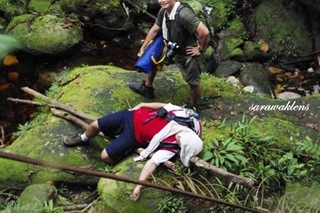
“Can’t… go… on… call me a heli!”


Part 6 – race against time!

From our campsite, we started trekking again just before 7AM. The night’s rest did me little good as I was awake for most of the night suffering from skin allergies (from bathing in blackwater). My two friends suffered no such reaction; they slept well for most of the night and could carry on the next morning with renewed energy and stamina. On the other hand, I became the slowest one, quickly left behind by several meters to trudge alone with sweat running profusely down my brow and stinging my eyes.


With just 5 kilometers left to cover, we were hoping to reach our destination before noon. We had made arrangements for our boatman (from the day before) to pick us up at 12:00pm. So it was important for us to reach the beach at Teluk Limau on time.


Oh by the way, the photo above, that situation isn’t real of course. While we were most definitely tired, we weren’t *that* tired! Took the photo just for laughs to show our friends. haha! When most saw it they initially thought it was real and were quite shocked. They thought that if regular trekkers could be so knackered, then it must be one seriously tough trail! We were supposed to go again in one big group but many voted to go by boat instead of on foot after hearing our stories. LOL! Will write about our second visit when I’m finished with this series.


Teluk_Limau_trail_Bako_National_Park_05

One of the many hills encountered along the way. At this particular point, a small trail branches off to the left (note signboard) leading to Teluk Lakei beach about 500 meters away. Though near, we couldn’t visit the beach as we were short on time.


This second part of our adventure proved to be very strenuous as the Limau trail moves over multiple hills big and small. Every hill we encountered I marked in my GPS. Looking at the topo map of the peninsula confirms my hill count; we had walked over multiple hills, more than 10, perhaps close to 20. Most were easy; short climbs and gentle slopes until we reached the last few which were particularly tough. We were certainly not helped by the fact that we were already quite sapped of energy. I was also quickly running out of water and kept looking at my GPS to see how far the next stream was. Every 100 meters felt like a kilometer!
 

Teluk_Limau_trail_Bako_National_Park_09

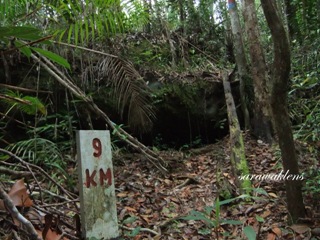
The milestones are placed about 100 meters apart and we took about an hour to cover each kilometer.


Loss of water became a serious threat as all of us were sweating like crazy in the warm and humid jungle. As I stood still to enter a waypoint in my GPS unit, sweat would literally stream down my forehead as if I had a leaky water bag placed on my head! No exaggeration! My entire shirt was totally soaked and I must have wrung out more than a liter of sweat from my towel. And that’s just the water that was soaked up or wiped away from my brow, face and neck, not including water lost dripping off my back, chest and hands. So, chugging down water constantly and refilling at key spots with flowing water were critical to our accomplishment. Making several rest stops was also key to enabling us to continue without complications.
 

Teluk_Limau_trail_Bako_National_Park_10

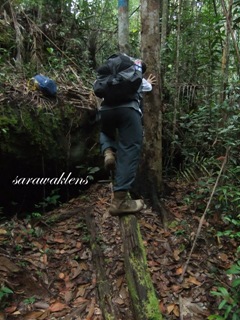
In some places, pieces of hardwood timber with foot notches hacked into them had been put in place to aid trekkers. These looked very old and blackened with age so we tested them for structural integrity before using them. The alternative was to ascend or descend by grabbing at tree roots or tree branches and perform some acrobatic acts to get through some tricky spots.


The profuse sweating really made me feel very uncomfortable. Not only did the sweat sting my eyes but it attracted a lot of bees which buzzed around me landing on my body, bag, hat, towel, hands or legs whenever I stopped for even a moment. To keep them at bay, I whipped out a bottle of mosquito repellent and sprayed my arms and legs.


The brand of mosquito repellent I used is “Mosiguard”. While quite effective against mosquitoes, it also contains ethanol, which is why it has a sticker on the bottle that reads “proven effective against leeches too!” No surprise there, stinging extracts and ethanol would be lethal to any leech and I can definitely confirm this cause I used it on a different trek and a light spray killed a leech within seconds! Fortunately, one of the best things about trekking in Bako is there are no leeches to worry about! Conditions are not suitable to those pesky blood suckers; the jungle is too dry on the peninsula which is surrounded by salty sea water on three sides.


Like the first half of our adventure, we moved through different forest types and ever changing landscapes but this time, we passed through more mixed dipterocarp jungle with tall giants. We also passed through some swampy areas with a species of Hanguana which I later found out to be new and undescribed. Also came across many fallen trees, some right across our paths, taking down smaller saplings and clearing the undergrowth where they fell.


Teluk_Limau_trail_Bako_National_Park_15

Treated tap water (left bottle) compared with water from the small streams we encountered. The tea color is due to iron oxides and tannins. No earthy smell whatsoever. I drank about 3 liters of this refilled blackwater which I had treated with NaDCC purifying tablets the night before. No bad chlorine smell as the water was left to sit overnight. Tasted pretty nice and sweet actually. All natural minerals. :)


Teluk_Limau_trail_Bako_National_Park_12

A swampy area with submerged Nepenthes mirabilis pitcher plants and a new, yet-to-be-described Hanguana species.


Teluk_Limau_trail_Bako_National_Park_33

“Warts” on a rock wall. Probably iron deposits. Friends said this looks like a wall with burst pimples hahaha


Teluk_Limau_trail_Bako_National_Park_45

Refilling water from the only clear-water stream we encountered, about 1.5 hours away from our destination. It is also the last stream encountered along the way before reaching Teluk Limau beach. By this point I was nearly out of water so I gladly filled up my empty bottles before moving on.


Teluk_Limau_trail_Bako_National_Park_54

Unlike the other blackwater streams we crossed, this last one was crystal clear. I was so thirsty I had to drink within an hour of dropping in the purifying tablets so had to put up with the nasty chlorine taste and smell! The maker of the tablets (Oasis) boasts no Cl smell or taste on their website shortly after dropping in the tablets but that’s total marketing BS. Even without personally testing it in the field, common sense would tell you otherwise. Best to fill up your bottles and let the water sit for a few hours or pass it through a portable filter before consumption.


Teluk_Limau_trail_Bako_National_Park_17

Climbing over fallen trees. All three of us took falls but nothing serious. Tiredness led to clumsiness and at one point, as I was trying to climb over a fallen tree trunk by first sitting on it, the weight of my bag and gravity pulled me swinging down, crashing back first into the ground. Thankfully my bag and its contents cushioned my fall and protected my head or it could have been ugly…


Teluk_Limau_trail_Bako_National_Park_18

Nasty looking thorns on a rattan species. Large plants are easy to spot and avoid, however some species send our long spines with sharp hooks (to aid climbing) that easily snag onto unsuspecting trekkers. They can cause quite a nasty gash so watch out for them!


Teluk_Limau_trail_Bako_National_Park_16

In a moment of clumsiness, I was snagged by a rattan spine full of back-turned hooks! A small piece became embedded in my palm just below my thumb; thought I had squeezed it out on the spot but the wound continued to itch and swell over the week and I eventually removed the tiny tip of a rattan hook from my flesh before the wound started healing again.


The jungle scenery along the way is really beautiful. Open grassy areas, kerangas forests, swamps, mixed-dipterocarp forests, palm forests and lowland jungle full of Pandanus plants, I’m still amazed at just how many jungle types we passed through walking this 13km trail. I think about the only type of plant missing (which is often found in other parts of Sarawak) is bamboo! Don’t recall seeing any or I may have missed them. Would have loved to do a bit of light exploring off trail in search of interesting things to photograph if I wasn’t so tired and pressed for time.
 

Teluk_Limau_trail_Bako_National_Park_35

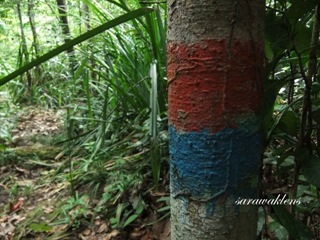
The color-coded trails in Bako are clearly marked. However, fallen trees found across some parts may sometimes obscure the markings so you do need to be trekking in good light to reduce the risk of getting lost. The trail pictured above passes through a wet, soggy area overgrown with Pandanus plants with serrated leave edges. Be prepared to have scratches and cuts on your legs if you trek in shorts.


After walking for about 4 hours, we finally reached the Teluk Kruin and Teluk Limau trail junction. There is a location map here with signs indicating remaining trail length to either beaches. No time for Teluk Kruin (which I visited on a separate trip a few weeks after this one) so we rested for a bit before making our way to Teluk Limau, 1.6km away.


Teluk_Limau_trail_Bako_National_Park_50

The Teluk Kruin/Teluk Limau junction with location map and trail markers. Right path takes you on a most scenic route to Teluk Kruin, left trail continues on to Teluk Limau. Both bays (and beaches) are about an hour and a half away from this point.


Teluk_Limau_trail_Bako_National_Park_48

Time for a quick snack, a nut and fruits energy bar. The raisins I brought along on the trek also proved very useful and replenished energy almost instantly. Remember to bring along some sweet stuff like chocolate bars or raisins to quickly replenish your blood sugar levels.


As we neared Teluk Limau, the forest type changed a few more times from mixed dipterocarp to kerangas to hill slope forest with palms and rattans to beach vegetation. Even though we were already very close to our destination, we made a couple more stops to drink and rest. That’s how tired we were!


Teluk_Limau_trail_Bako_National_Park_62

Some amazing sights to be seen along the way to the beach - giant boulders resting on each other and big fig trees sending out ramifying roots across the rock walls.


Teluk_Limau_trail_Bako_National_Park_66

Imagine our relief when we finally reached this point, just a hundred meters away from the beach! From here one could see the bay and the sea.


So after what seemed like 10 miles, we completed the remaining 3 mile trek from our campsite and reached our destination, Teluk Limau at 20 minutes past noon.


Our boatman was already there waiting under some shady trees and he was quite impressed with just how far we had walked. He told us he had never done that trail before himself and that many who attempted it failed and gave up half way. If I heard correctly, some even had to be picked up for the return journey back to HQ from Teluk Lakei, a beach located about an hour from where we set camp.


The feeling of accomplishment was greatly muted when we arrived at Limau because of fatigue but hearing what our boatman said made us feel a great sense of satisfaction! We were also the first three among our group of regular hiking friends to complete this trail and realizing this made us feel even more proud of what we had accomplished! Seriously, the park should consider handing out certificates to all those who complete this trail and return in one piece, haha!


Unfortunately, time was passing by quickly and as it approached 1:00pm, we had to leave Limau for Pulau Lakei (Lakei Island) to do a bit of exploring.


Teluk_Limau_trail_Bako_National_Park_69

Our boatman who waited for about half an hour for us. The beach at Teluk Limau is strewn with driftwood of all shapes and sizes. Unfortunately, the tide and waves not only bring in natural debris, but human refuse are swept in as well. Discarded plastic bottles, shoes, flip flops, tin cans, glass bottles, food wrappers, medicine bottles, paper boxes and who knows what else litter the upper part of the beach.
 

Teluk_Limau_beach_Bako_National_Park_74

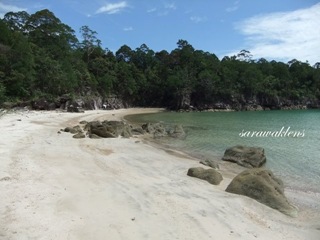
The lower part of the beach is absolutely beautiful. The bay is shallow and the water is crystal clear. We didn’t have time to swim here unfortunately…
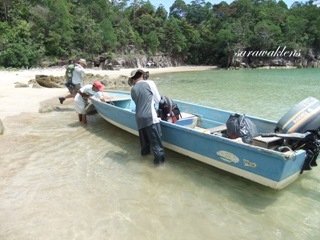
 

Teluk_Limau_beach_Bako_National_Park_80

Getting into the boat for the short journey to Pulau Lakei north of Teluk Limau.


Teluk_Limau_beach_Bako_National_Park_81

Goodbye, Teluk Lakei!!


So there you have it, the end of part 6. Going through the pictures again and reliving the experience through words has made me realize how much fun this trek really was. Minus the heavy load, it would probably have been one of the most amazing trails I've ever done (instead of being one of the toughest). Beautiful scenery left and right and so much to see!


Next part in this series will be about Pulau Lakei! Thanks for reading and hope ya’ll enjoyed this entry.


Photo gallery – click on thumbnail for larger size

Teluk_Limau_trail_Bako_National_Park_30 Teluk_Limau_trail_Bako_National_Park_01 Teluk_Limau_trail_Bako_National_Park_04 Teluk_Limau_trail_Bako_National_Park_06 Teluk_Limau_trail_Bako_National_Park_07 Teluk_Limau_trail_Bako_National_Park_08 Teluk_Limau_trail_Bako_National_Park_11 Teluk_Limau_trail_Bako_National_Park_14 Teluk_Limau_trail_Bako_National_Park_19Teluk_Limau_trail_Bako_National_Park_20 Teluk_Limau_trail_Bako_National_Park_21 Teluk_Limau_trail_Bako_National_Park_22 Teluk_Limau_trail_Bako_National_Park_23 Teluk_Limau_trail_Bako_National_Park_25 Teluk_Limau_trail_Bako_National_Park_26 Teluk_Limau_trail_Bako_National_Park_27 Teluk_Limau_trail_Bako_National_Park_28 Teluk_Limau_trail_Bako_National_Park_29  Teluk_Limau_trail_Bako_National_Park_31 Teluk_Limau_trail_Bako_National_Park_32 Teluk_Limau_trail_Bako_National_Park_34 Teluk_Limau_trail_Bako_National_Park_37 Teluk_Limau_trail_Bako_National_Park_36 Teluk_Limau_trail_Bako_National_Park_38 Teluk_Limau_trail_Bako_National_Park_39 Teluk_Limau_trail_Bako_National_Park_40 Teluk_Limau_trail_Bako_National_Park_43 Teluk_Limau_trail_Bako_National_Park_42 Teluk_Limau_trail_Bako_National_Park_44 Teluk_Limau_trail_Bako_National_Park_46 Teluk_Limau_trail_Bako_National_Park_47 Teluk_Limau_trail_Bako_National_Park_49  Teluk_Limau_trail_Bako_National_Park_51 Teluk_Limau_trail_Bako_National_Park_52 Teluk_Limau_trail_Bako_National_Park_53 Teluk_Limau_trail_Bako_National_Park_55 Teluk_Limau_trail_Bako_National_Park_56 Teluk_Limau_trail_Bako_National_Park_57 Teluk_Limau_trail_Bako_National_Park_58 Teluk_Limau_trail_Bako_National_Park_59 Teluk_Limau_trail_Bako_National_Park_61 Teluk_Limau_trail_Bako_National_Park_60 Teluk_Limau_trail_Bako_National_Park_63 Teluk_Limau_trail_Bako_National_Park_64 Teluk_Limau_trail_Bako_National_Park_65 Teluk_Limau_trail_Bako_National_Park_67 Teluk_Limau_trail_Bako_National_Park_68 Teluk_Limau_trail_Bako_National_Park_70 Teluk_Limau_trail_Bako_National_Park_71 Teluk_Limau_trail_Bako_National_Park_72 Teluk_Limau_trail_Bako_National_Park_73 Teluk_Limau_beach_Bako_National_Park_75 Teluk_Limau_beach_Bako_National_Park_76 Teluk_Limau_beach_Bako_National_Park_77 Teluk_Limau_beach_Bako_National_Park_78 Teluk_Limau_beach_Bako_National_Park_79

Related Posts Plugin for WordPress, Blogger...