Showing posts with label fish. Show all posts

Monday, November 28, 2011

Limnophila species (native aquatic plant)

Limnophila_aquatic_plant_1

Found lots of Limnophila growing in this small drain flowing through a paddy field some weeks ago. This aquatic plant is native to Borneo (and SEA) and is often found growing in rice fields. It’s actually quite an attractive plant and would make a great background plant in a planted tank. The leaves that emerge above water are broader and slightly thicker while the submerged leaves are fine and feathery.

The fine leaves underwater were unfortunately covered with a layer of mud, otherwise they would look really nice even when photographed on a dull day (with polarizer of course).

Saw lots of fish in the water; was hoping to spot a gourami or two but spotted only common rasboras.

It was a rainy day so the photos are a rather dull and dark. Though I was using a different camera than my usual outdoor cam, I was still able to get some decent shots with a circular polarizer meant for my Olympus by holding the CPL in front of the lens. It wouldn’t fit the Sony lens because of the different filter thread size.

Limnophila_aquatic_plant_2Limnophila_aquatic_plant_3Limnophila_aquatic_plant_4
Friend snapping some underwater shots with an Olympus Tough TG-810. :)

Limnophila_aquatic_plant_5
Photographed with CPL

Limnophila_aquatic_plant_7Limnophila_aquatic_plant_6
Left: wtihout CPL; Right: with CPL. The polarizer didn’t fit (different thread size) as it’s for my other cam but I held it in front of the lens, better than nothing. :)

Thursday, September 23, 2010

Rasbora cephalotaenia

This beautiful freshwater fish is usually found in
blackwater streams and rivers in Malaysia, Indonesia and Thailand.
It has very beautiful colors with almost neon,
shimmering blue lines running the length of its
flanks when sunlight hits at the right angle.
This one was caught in a peat swamp. As one can see from the photos above, it is quite a large rasbora with adults growing to more than 10 cm in length. The fish above was
released again after photos were taken.
Published with Blogger-droid v1.5.9

Tuesday, April 20, 2010

A “fishy” outing


blackwater_peatswamp_fish_species_04


Went on another photo outing, this time to catch and photograph peat swamp fish species.


blackwater_peatswamp_fish_species_09

Carinotetraodon sp., possible Carinotetraodon salivator.


blackwater_peatswamp_fish_species_10

Carinotetraodon sp.


These tiny little puffers are sooooo cute. One puffed up into a tiny ball as big as a marble and I was fortunate to have my camera ready just then!


blackwater_peatswamp_fish_species_02

Puntius hexazona


blackwater_peatswamp_fish_species_01

Puntius hexazona


It was also my first time seeing the beautiful six banded barb, Puntius hexazona as well as another colorful rasbora.


blackwater_peatswamp_fish_species_07

Rasbora sp.


Still waiting for my fish guru to ID that one. I made up a name for it in the meantime, the "Rainbow rasbora" as it appears to have colorful bands running the length of its body.


blackwater_peatswamp_fish_species_03


How sad that more and more streams are turning into smelly polluted streams. We visited many places in the countryside to look for blackwater rivers and peatswamps to explore but runoffs from poultry farms, pig farms and vegetable gardens have done a lot of damage.


blackwater_peatswamp_fish_species_05


It was only after driving around and exploring for several hours that we eventually found a stream still nice and unspoiled. *sigh*


blackwater_peatswamp_fish_species_12

Photographing a juvenile pikehead.


blackwater_peatswamp_fish_species_13

A Luciocephalus species, predatory pikehead.


Far away in the countryside, we also had the good fortune of spotting a hornbill in flight. Not the large greater hornbill but a smaller species. I couldn't change lenses fast enough so no photo of that hornbill. Maybe a “birding” or bird watching trip next time!

Monday, April 19, 2010

Tiny freshwater pufferfish

Carinotetraodon_freshwater_puffer_fish_6
This tiny one, about 1.5cm long, just ate an insect larva and is looking for more.

This species of freshwater pufferfish, believed to be Carinotetraodon salivator,  is the cutest little puffer I’ve ever seen. Pretty interesting to observe them swim around in a tank, eyes moving about searching for prey.

The large one is about an inch long and the small one is about 1.5cm long. Before I took these photos, I fed them damselfly larvae and soon as I dropped the larvae in, both started going after them. Some of the larvae hid among the Egeria densa leaves but the puffers eventually got to them.

There was a big dragonfly larva too, as big as the smaller puffer and the larger puffer kept nipping at it. By night, it'll probably be fishfood.

Carinotetraodon_freshwater_puffer_fish_5
The larger, 1 inch adult “stalking” a damselfly larva.

Besides insect larvae, they also feed on small snails and fish. So they are a good choice to naturally control a small snail infestation in a freshwater tank!

Photo quality is pretty poor cause the water is dark, stained with tannins and I'm shooting at 800-1600 ISO through plastic. Here are more photos of this little fish:

Carinotetraodon_freshwater_puffer_fish_3

Carinotetraodon_freshwater_puffer_fish_4 fr

Carinotetraodon_freshwater_puffer_fish_2

Friday, April 2, 2010

A fun outing with two ichthyologists

Now and then it's good to go out with a different crowd and learn something new. Earlier this week I went with two ichthyologists from the Natural History Museum of London to look for black water fish species in peat swamps (they have all relevant papers and permits in case you’re wondering). They did all the looking, catching, and bagging, getting wet and dirty while I stayed dry and just snapped photos. :)


It also gave me an opportunity to snap photos of wild orchids and other flora found in the swamps.


The two day trip opened my eyes to a different world and field. As a kid I used to catch fish for my small aquariums such as rasboras and barbs but I never knew there were freshwater puffers, leaf fish and other types of carnivorous fish in our small black water streams! These unique species are now greatly threatened by habitat destruction, development and agricultural wastes.


Being already familiar with Latin names and scientific names of plant species, learning the names of fish species I've always taken for granted wasn't difficult. The three types that I was most fascinated with were the black water puffer, Carinotetraodon salivator, a small thumb-sized puffer as cute as a button; a species of leaf fish, (Nandus sp.); and a two spot rasbora, Rasbora kalachroma, a beautiful species I've never caught or seen before.


Certainly piqued my interest to learn more about our freshwater species, especially those found in peat swamps and black water streams.


Oh and we had a fair bit of drama on day 1, when our rented 4wd got stuck in the soft peat in one of the areas we visited. But that's a story that deserves its own entry. ;)


collecting_black_water_fish_species_15

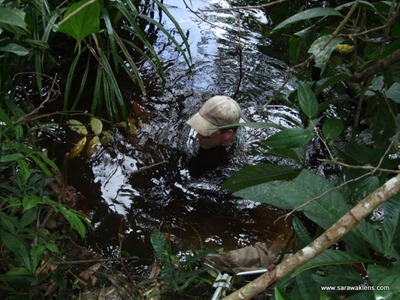
This is the only picture I have of the two of them in the same frame. Pretty brave to go in like that, who knows what’s lurking in the water!

“Are there are crocodiles in here??”

“We’ll find out soon!”


OLYMPUS DIGITAL CAMERA          

Before heading to the swamps, we made a quick stop at the fish market. Pictured here are three different species of anchovies. According to my new fish friends, the middle one is a Setipinna species while the other two are Coilia species.


OLYMPUS DIGITAL CAMERA

An unidentified fish which looks like a goby. Apparently this was a stray catch and no one wanted to buy it so the fish monger gave it to the scientists for free.
 

collecting_black_water_fish_species_04

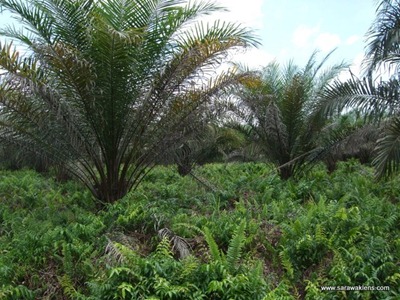
Our next stop was a destroyed peat swamp. The original trees have been cleared and replaced by the African oil palm. It’s an intrusive monoculture that is rapidly taking over Borneo and drying up vast areas of land, swamps and wreaking havoc to the eco system. Like all other monocultures, the tree itself isn't evil and the oil it produces isn't that bad either (don't believe all the negative propaganda designed to protect another set of economic interests), it is HUMAN GREED that's destroying our world.


collecting_black_water_fish_species_01

Rasbora kalachroma


OLYMPUS DIGITAL CAMERA

Luciocephalus sp. , a small black water pikehead often found in peat swamps. It is a predatory species.


collecting_black_water_fish_species_03

“Sigh, not much luck here…”


collecting_black_water_fish_species_05

So we decided to move further in. Because we had too much stuff in the car, we decided to drive in instead of walking. BIG MISTAKE! The soft peat soil quickly trapped our 4WD and we spent about 3-4 hours stuck in there until my good friends drove all the way from the city to rescue us! We were also helped by two good Samaritans. A friend in need is a friend indeed! It was a bit too much adventure for one day and a story that shall be told in a separate entry. :)

 

collecting_black_water_fish_species_06

Back from the swamps and watching their peers on TV, a National Geographic program featuring the Congo.


collecting_black_water_fish_species_07

Day 2, we started early and headed to a different location. After driving around for about an hour, we finally located a small black water stream. This find set the adrenaline going again and the scientists quickly changed into their mucking gear and jumped in without hesitation. I, of course, stayed perfectly dry snapping away with my two cameras. There were lots of orchids to be photographed by the stream and I wasn’t going to waste any time! Something for everyone!


collecting_black_water_fish_species_09

Tannins from decomposing organic matter stain the water and give it a near black color.
 

betta_wild_fighting_fish_species_3

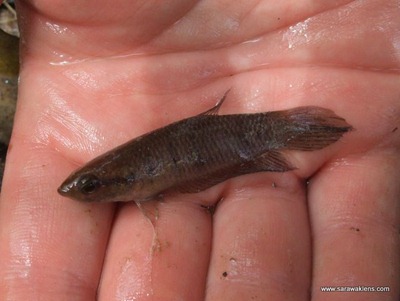
First big find! A beautiful betta species, wild fighting fish. From this find onwards, they knew they had struck gold. More exotic fish species were to be found. Only one eluded the scientists’ nets that day, the tiny Paedocypris species, one of the smallest fish in the world measuring only about 1cm in length fully grown.


betta_wild_fighting_fish_species_2

Betta sp.


collecting_black_water_fish_species_10

A small loach.


collecting_black_water_fish_species_12

Small fresh water crab.


collecting_black_water_fish_species_14

Luck was not on his side that day. Not only did too much sand get into his extendable net tube, causing it to jam up, he kept losing his shoes which easily got stuck in the clay and sand in the riverbed.


collecting_black_water_fish_species_16

Baby catfish. This species has a large gaping mouth, just imagine what a formidable predator it will become when fully grown!


OLYMPUS DIGITAL CAMERA

Besides bettas, half beaks and rasboras of all sizes were also caught.


OLYMPUS DIGITAL CAMERA

This isn’t even the deepest part. There was a part where the water came up to his chest.


freshwater_puffer_carinotetraodon_salivator_1

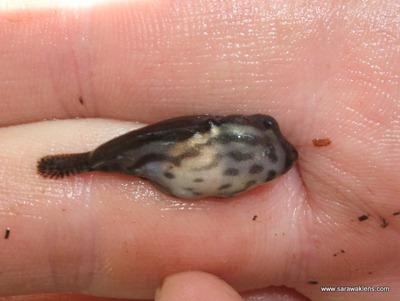
This cute little thumb-sized puffer is believed to be Carinotetraodon salivator.
freshwater_puffer_carinotetraodon_salivator_2

Another shot of the tiny little black water puffer.


nandus_species_leaf_fish

A leaf fish, Nandus species. I never knew they existed in our waters! So naturally, I was all oohs and aahs!


betta_wild_fighting_fish_species_1

A betta and rasbora, collected for scientific research.


It was a fun outing and I look forward to more adventures where I get the opportunity to learn and discover new stuff!

Sunday, January 24, 2010

A natural jungle spa

stream_in_Borneo

I really like this place. It’s so peaceful and unspoiled here. The only sounds to be heard are all natural sounds, birds chirping, tree frogs croaking and water gurgling. No manmade noises, no cars honking, no trucks rumbling and definitely no loud people talking and yelling. A perfect place to unwind and just soak in nature.

It’s located in Middle of Nowhere, secluded and safe from day trippers and litter bugs from the city. There are many “middles of nowhere” all throughout Sarawak and all it takes is a few hours of driving + trekking to get to a place where one can be totally immersed in the natural beauty of a pristine jungle.

DSCF2397
Postcard perfect!

small_waterfall_ferns
Very Hawaii-like, no?

petrified_tree_trunks_across_stream
Ferns of all kinds and large petrified tree trunks lend a very “lost-world” feel to this place.
 
natural_fish_foot_spa
Natural fish foot spa! The freshwater fish here are not afraid of people because so few human beings come here. As soon as I got my feet in, the fish all swarmed around to nibble at flakes of dead skin. Some people pay good money to have this treatment.

DSCF7012
The small stream is full of T-barbs and rasboras that love to nibble on flakes of dead skin. Even small freshwater shrimp join in!

feet_in_water_natural_fish_foot_spa
The fish may be little but they do have rather sharp teeth! Very ticklish at first but after a while you get used to it. Great to just sit back with a book and let the fish do their job. :D

DSCF7025
In this deep pool, more fish await to give a full body fish spa treatment! Just dip in, stay afloat or sit still in a shallow area and the fish will come to you.

DSCF7038
Ahhhh… this is the life!

DSCF7052
After the fish spa treatment, just jump in for a swim! The waterfall may be small but the pool is actually very deep! Though the water is clear, it is too deep to see the bottom.

small_waterfall
I love this small water cascade. Wish it was in my backyard!

waterfall_water_massage
Waterfall massage, very relaxing!

jungle_pool_natural_spa
Relaxing in the upper pool of the natural spa.

OL210280
The upper pool, very clear and cool water.

OL210286
As I lay back and float in the water, I feel totally relaxed. Looking up, all I see are tall trees and greenery and all I hear are natural sounds. Perfect place to de-stress!

Olympus_e510_Sony_A350_Tamron_SP_60mm
SLRs in the wild. :) Olympus E-510 on the left and Sony A350 on the right.

OL210088
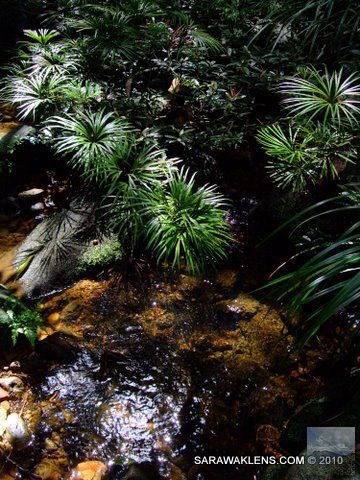
A small clear water stream flowing through the quiet jungle.

OL210095
Pandans grow abundantly along the banks.

Cryptocoryne_striolata_in_natural_habitat
A species of aquatic aroid, Cryptocoryne striolata grows in abundance near the banks.

OL210098
The water in the stream comes from a nearby mountain and is very cool. Great place to go for a dip. Over hanging tree branches and lianas provide shade from the hot sun.

OL210132
Such clear streams used to be a common sight near Kuching. In just a couple of decades, many have turned black and polluted by wastes from pig farms (by far the worst!), chicken farms, run-offs from plantations, household refuse and trash chucked away by irresponsible people. Very sad!

OL210166
I like this small little stream. On both banks are heliconia-like plants. I’m not sure what they are.

OL210183  
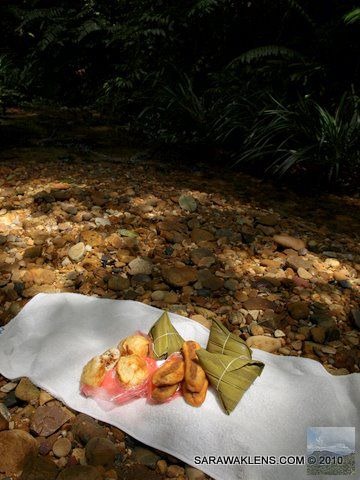
Great place for a small picnic lunch too. Dumplings, spice breadsticks and yam puffs stuffed with char siew meat.

tree_trunk_mushrooms
A dead tree trunk full of mushrooms.

jungle_stream_ferns
Beautiful ferns (Dipteris lobbiana) grow abundantly along the stream.

OL210225
Just looking at this picture again makes me miss the place already!

OL210226
Many small cascades and waterfalls can be found here.

Spider_and_prey
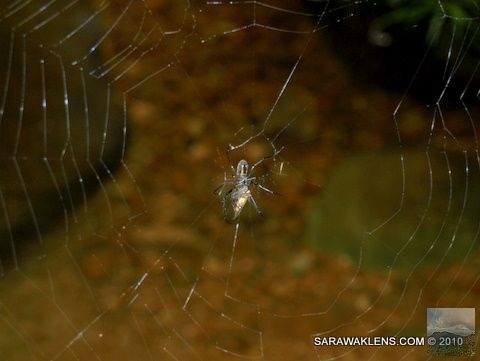
Amazing architects, spiders string their webs from one bank to another, catching unlucky flying insects such as damselflies.

OL210231
A small water cascade.

OL210236 
Sandstone boulders.

OL210253
Pandans and ferns.

OL210270  
I often see this fern species growing along clear water streams. Refer next photo for closer view.

fern_species
Dipteris lobbiana. If anyone has a clue what fern species this is, do drop me a line or leave a comment.
 
jungle_pool_waterfall_pebbles
We brought back all that we took in and left the place as we found it, without a single trace of our visit. Hope it stays pristine like this for as long as possible. Can’t wait to return here again!
Related Posts Plugin for WordPress, Blogger...